

The quick answer
Echo comes from hard, bare surfaces that bounce sound around the room. To cut it, add soft, porous material on those surfaces: a thick rug, heavy folded curtains, upholstered furniture, and fabric-faced acoustic panels where the sound bounces most. Wood paneling and ordinary paint do almost nothing on their own. Nothing here makes a room soundproof, because stopping noise from leaving needs a different fix.
A room that echoes makes speech harder to follow and everyday noise feel louder. It also makes people raise their voices, which makes the room louder still. Echo is the easier problem. You don't need to block anything. You need to soak up sound that would otherwise keep bouncing.
This guide covers the physics first, then each common situation: high ceilings, hallways, low-cost fixes, wood paneling and sound-absorbing paint. It sticks to what the published sources and lab data support, and it marks our own judgement as judgement.
How Echo Works and How It's Measured
Two different jobs get lumped together as "soundproofing." Acoustic treatment improves the sound inside a room by absorbing it. GIK Acoustics, a maker of acoustic panels, says most treatments absorb sound waves, which improves the sound within a space, and that they only somewhat dampen sound passing from one room to the next. The same company says the only real way to keep sound from passing through a wall is mass, and describes building an extra wall with an air gap and insulation. So this guide is about the first job. If your real problem is noise getting in or out, see our soundproofing guide.
Two ratings show up on product pages.
- NRC (noise reduction coefficient) rates absorption. It is a single number, rounded to the nearest 0.05, that averages how much a material absorbs in four bands centered at 250, 500, 1000 and 2000 Hz. A scale of 0 to 1 is the usual range, though some products test slightly above 1.00. Higher is better for echo.
- STC (sound transmission class) rates blocking. Riverbank Acoustical Laboratories describes it as a single number for how well a building material or partition blocks airborne sound. It says nothing about echo inside the room.
The two don't predict each other. A wall panel can have a high NRC and a low STC. For echo, look only at NRC.
One published guide on NRC says a difference of 0.05 to 0.10 between similar materials has little audible effect, 0.10 to 0.20 is significant, and 0.20 or more is considerable. In practice that means a 0.9 panel beats a 0.5 panel by a clear margin, while 0.85 versus 0.90 is not worth paying for.
Where to put absorbers. Treat the paths the sound actually takes, not random wall space. Retail acoustics guides point to the same priorities: first reflection points on side walls and ceiling, then the wall behind the listener, then facing parallel walls. To find a reflection point, sit where you usually sit and have someone slide a small mirror along the wall. Wherever you can see the sound source in the mirror, sound bounces to you from that spot. One retailer suggests covering roughly 15% to 30% of wall and ceiling area, and says coverage under 10% gives minimal improvement. That range is a rule of thumb from a seller, not a standard, so treat it as a starting point and listen as you add.
Absorbers also work better at some pitches than others. Soft, thin materials absorb high frequencies well and low frequencies poorly. That is why a rug and curtains tame a sharp, ringing room but won't remove a boomy one.
Echo in Rooms With High Ceilings

A tall room gives sound a long path between hard surfaces: bare floor, flat ceiling, glass and plaster walls. Each bounce is a reflection you can hear as echo or "ring." The same retailer's placement guide suggests adding about 15% to 30% more absorber when the ceiling is 2.7 m (about 9 ft) or higher, and recommends ceiling panels where hard floors or high ceilings create vertical reflections.
- Start at ear height. The fastest gain is on the walls you can reach: curtains, a large rug, upholstered seating, and fabric-faced panels hung at roughly 4 to 6 ft, the height that guide recommends.
- Treat the ceiling if the room still rings. Hung panels or clouds over where people sit catch the reflection before it reaches the ceiling and returns. Fabric-wrapped panels meant for ceilings are the usual choice.
- Space panels off the surface when you can. A manufacturer's data sheet for a slatted acoustic wall panel gives NRC 0.55 when mounted flat, 0.70 with a 1 inch air space and 0.80 with a 2 inch air space. The panel is the same each time. Only the gap changes.
- Break up long bare walls. Furniture, bookcases and hangings stop a clean, flat reflection. Uneven surfaces such as bookshelves scatter sound rather than absorb it, which still helps.
Vaulted and open-plan spaces can need more material than a normal room. If a large room is still too lively after rugs, curtains and a few panels, an acoustic consultant can measure it and say how much absorption it needs. We found no reliable home-use figure for that, so we don't quote one.
Echo in a Hallway
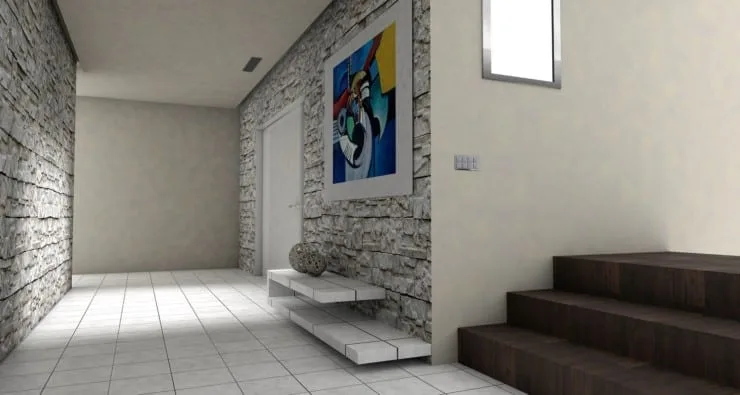
Hallways are close to the worst case for echo: narrow, parallel walls, a hard floor and little furniture. The placement guide above says to treat opposing walls so sound stops bouncing between them, "especially in rectangular rooms and hallways." It also says rugs reduce floor reflections.
- Add a runner. A thick runner covers the floor, which is usually the largest bare surface. Fix it with a non-slip underlay so it doesn't become a trip hazard.
- Offset the treatment. Put absorbing material on one wall at a time, and stagger it so it doesn't sit directly opposite on the other wall. This is our judgement from how reflections work. A few fabric panels, a felt or fabric wall hanging, or a coat-and-shoe storage unit with fabric items do the job.
- Be careful with framed glass art. Glass is a hard surface and reflects sound. Fabric or felt pieces, or canvas, do better.
- Use the door, if there is one. A soft curtain at one end of a long hall cuts the run of sound along it. This is judgement, not tested data.
Hallways are often too narrow for thick panels to stick out. Thin fabric panels and hangings give less low-frequency absorption, but they are enough to take the sharp edge off a hall.
Low-Cost Ways to Reduce Echo

You don't need a purpose-built panel to improve a lively room. Soft, thick, porous items absorb sound. Work from the biggest bare surface down.
- Rug on a hard floor. The floor is usually the largest hard surface. A thick rug with a dense pad underneath absorbs more than a thin flat weave.
- Heavy curtains, hung in folds. A published absorption table lists curtains with generous gathering hung away from the wall as absorbing mid and high frequencies well, with little effect on bass. Thin sheer curtains absorb far less. Full-width, folded, lined curtains do better.
- Upholstered furniture and cushions. A sofa and soft chairs are absorbers. A mostly empty room with one hard chair echoes more than a furnished one.
- Bookshelves. Filled shelves break up flat walls and scatter reflections. They are not strong absorbers, so count them as a small help.
- Fabric wall hangings and quilts. A thick quilt or heavy fabric piece on a bare wall adds a little absorption. Hanging it a couple of inches off the wall helps for the same reason spaced panels do.
- DIY panels. A wooden frame with mineral wool or rigid fiberglass inside and breathable fabric over the front is a common home build. Wear a mask and gloves when cutting insulation, and keep the fabric cover on so loose fibers don't shed into the room. Our own page on natural sound-absorbing materials covers material choices.
Plants. Real plants make a room feel softer, but we found no measured absorption data we could cite for houseplants. Don't count on them to fix an echoing room. Use them for looks and let rugs, curtains and panels do the work.
Stack changes. One rug rarely fixes a large bare room. Add a rug, then curtains, then a few panels, and clap once in the middle of the room after each change. The ring should shorten each time.
Does Wood Paneling Absorb Sound?
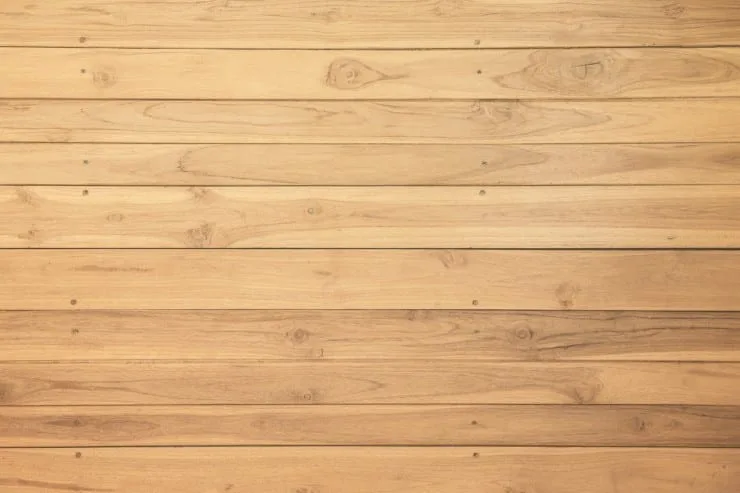
Mostly no. Wood is a hard, dense surface, and hard surfaces reflect sound. The sources we found describe plain wood slats as scattering sound, which spreads reflections out but doesn't remove the sound. A manufacturer of slat panels says it directly: the wood scatters and diffuses sound, and the acoustic felt backing absorbs it.
That's the key to telling real acoustic wood panels from decorative ones.
- Thin veneer or flat paneling stuck to a wall does little. A flat panel glued to drywall is still a hard face. Don't expect it to cure an echo. (Judgement, based on the hard-surface principle above.)
- Slatted panels with felt or mineral wool behind them do absorb. One slatted wood panel data sheet lists wood-veneered MDF on a polyester felt backer. It reports NRC 0.55 mounted flat, 0.70 with a 1 inch gap and 0.80 with a 2 inch gap. A second maker lists NRC 0.55 for its felt-backed slat panel. The absorption comes from the felt behind the slots.
- Low frequencies are still weak. The same data sheet shows absorption of only 0.08 at 125 Hz and 250 Hz for the flat-mounted panel, rising to 0.70 at 1000 Hz and 1.07 at 2000 Hz. These panels help speech and clatter, not bass boom.
One maker claims a slatted product reaches NRC 0.8 to 0.95 with added rock wool and an air gap. That is a marketing range for a particular build, so ask for the lab report for the exact configuration before you rely on it.
If you already have solid wood paneling and want the room quieter, leave the wood and add rugs, curtains and soft furniture around it. If you want wood as a look and need absorption, buy a slat panel with a tested NRC and a felt or mineral wool backing.
Does Sound-Absorbing Paint Work?
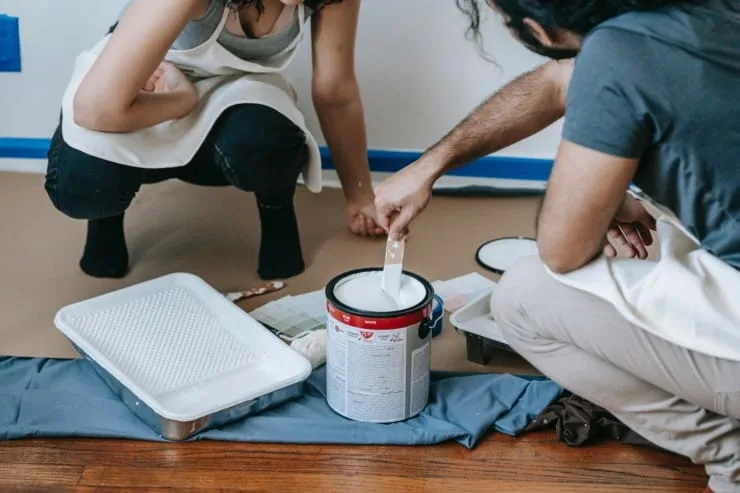
Ordinary paint does not absorb sound, and a normal coat of any paint is too thin to change a room. A published absorption table lists smooth, painted concrete at about 0.01 to 0.02 in each frequency band. That is close to zero absorption.
Research from Aalto University's acoustics lab says most acoustic coatings on the market are non-absorbing. They are used on top of acoustic panels to hide seams, and the panels do the absorbing. It also says a coating that is too thick degrades the panel underneath.
Paint can also hurt a good absorber. Two lab tests on identical 2 inch fiberglass panels, run to ASTM C423 at an NVLAP-accredited lab, measured the bare panel at NRC 1.00 and a roller-painted panel at NRC 0.50. Primacoustic made the panels, and the test reports don't explain the drop. A trade magazine article makes the same warning in plain terms: don't seal the surface pores or apply paint so thick that it forms a hard shell. It tells of a hall with good acoustics that turned into an echo chamber after several coats of enamel.
Specialist coatings exist, but they are not paint. The Aalto study tested a sprayed biofiber coating 10 mm thick. On hard surfaces it reached sound absorption class D with a weighted coefficient of 0.35, which is real but modest, and it only comes from applying a thick, textured layer. The authors note that the coating's thickness limits its performance. We found no independent test of the thin "acoustic paint" products sold in hardware stores, so we can't confirm what they claim.
Verdict: don't buy paint to fix echo. If a seller's page gives an NRC, look for an ASTM C423 lab report that shows how the product was mounted and how thick it was applied. If it shows no report, spend the money on a rug and curtains.
Frequently Asked Questions
What is the cheapest way to reduce echo in a room?
Cover the largest hard surface first. Put a thick rug on a hard floor, hang full, lined curtains in folds, and add upholstered furniture. These soft, porous items absorb sound. Add fabric-faced panels only if the room still rings after that.
Does wood paneling absorb sound?
Mostly not. Wood is a hard surface and reflects sound. Slatted wood panels with a felt or mineral wool backing do absorb, because the backing does the work. One tested example is rated NRC 0.55 mounted flat and 0.80 with a 2 inch air gap.
Does sound-absorbing paint reduce echo?
Not by itself. A published table lists painted smooth concrete at about 0.01 to 0.02 absorption. Paint on a porous absorber can lower its rating: one lab tested the same fiberglass panel at NRC 1.00 bare and NRC 0.50 roller-painted.
What do NRC and STC mean?
NRC rates how much sound a material absorbs, on a scale of about 0 to 1, and it is the number that matters for echo. STC rates how well a wall, door or window blocks airborne sound passing through it. A high NRC does not mean a material blocks sound.
Where should acoustic panels go?
Start at the first reflection points on the side walls and ceiling, found by sliding a mirror along the wall while you sit in your usual spot. Then treat the wall behind you and any pair of bare parallel walls. One retailer suggests covering about 15% to 30% of wall and ceiling area, as a starting point.
Sources
- GIK Acoustics: Acoustic Treatment vs Soundproofing (absorption improves sound in a room; blocking needs mass and an air gap)
- Noise reduction coefficient (Wikipedia, citing ASTM C634) (NRC definition, bands averaged, what NRC differences sound like)
- DDS Acoustical: Differences Between STC and NRC Ratings (NRC scale and values above 1.00)
- Riverbank Acoustical Laboratories: Understanding STC (what STC measures)
- Walls and Floors: Where to Place Acoustic Panels (placement priorities, coverage rule of thumb; a retailer guide)
- Sound Assured: How to Find First Reflection Points (mirror method; bookshelves scatter sound)
- Acoustical Solutions: AlphaSorb Slatted Wood Panel Data Sheet (NRC by mounting, frequency data, felt backing)
- Stikwood: Are Slatwood Panels Really Acoustic? (slats scatter, felt absorbs; manufacturer claim)
- Felt Right: Benefits of Wood Slat Wall Panels (wood diffuses, felt absorbs; NRC 0.55 claim)
- Riverbank test report, unpainted fiberglass panel (Primacoustic) (NRC 1.00)
- Riverbank test report, roller-painted fiberglass panel (Primacoustic) (NRC 0.50, ASTM C423)
- Aalto University: Sprayed sound-absorbing coating on non-acoustic materials (most coatings are non-absorbing; 10 mm coating tested at 0.35)
- Productions Magazine: Modern Acoustical Design (don't seal pores; enamel on a hall)
- Absorption coefficients table (akustik.ua) (painted concrete near 0.01 to 0.02; curtain absorption by frequency)